Forty-Two Years on Wudang
The prince of Jingle Kingdom left his throne for Wudang Mountain, cultivated for forty-two years, and ascended in broad daylight. Wudang's cliff-temples are the stations of his cultivation.

道法自然
真武大帝
Emperor of the Northern Heavens
Festival · 3rd day of the 3rd lunar month
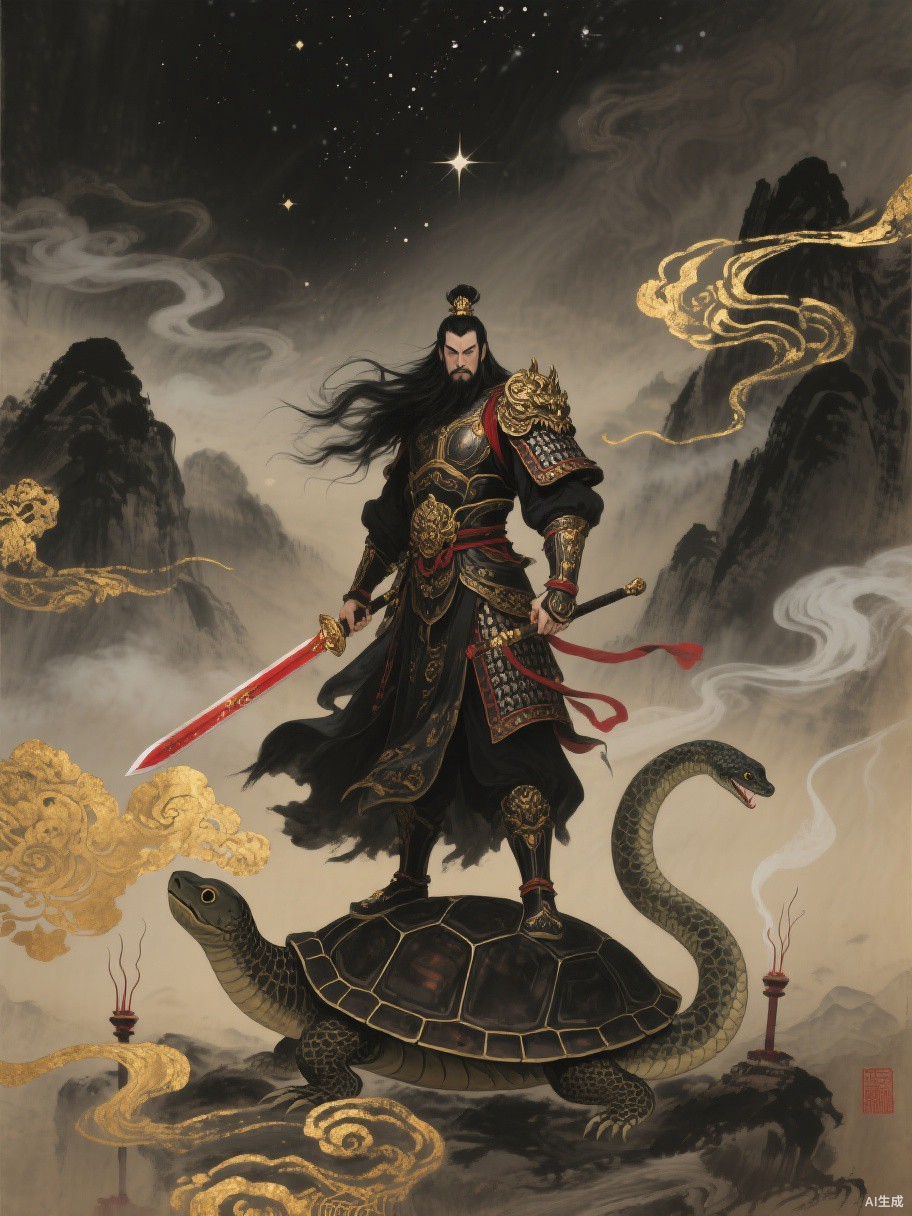
Emperor of the Northern Heavens
A prince who left his palace to cultivate the Tao on Mount Wudang, attaining immortality after decades of ascetic practice. The great Taoist mountain complex of Wudangshan is devoted to him, and he is depicted with sword drawn beneath the northern stars.
Festival · 3rd day of the 3rd lunar month
History · 史记
Zhenwu Dadi, the Perfected Warrior, began as the Black Warrior — the tortoise-snake of the north, one of the four celestial emblems. The Li Ji already records it: in front the Vermilion Bird, behind the Black Warrior. From the Song onward he evolved into a warrior god in his own right; to avoid the taboo character of the Song imperial house, Xuanwu was renamed Zhenwu — the True Warrior.
Legend makes him a prince who abandoned his throne to cultivate on Wudang Mountain for forty-two years, until in broad daylight he ascended to heaven; even his stomach and intestines, discarded as impure, became the tortoise and snake generals beneath his feet. The Ming Yongle emperor, claiming the throne with Zhenwu's blessing, rebuilt Wudang into the greatest of Taoist mountains.
The prince of Jingle Kingdom left his throne for Wudang Mountain, cultivated for forty-two years, and ascended in broad daylight. Wudang's cliff-temples are the stations of his cultivation.
At the moment of perfection he cut away his stomach and intestines; they sank into the earth and became demons of tortoise and snake. He subdued them and bound them beneath his feet as generals — the impure, mastered, becomes power.
禮記·曲禮
The earliest text naming the Black Warrior among the four celestial emblems.
宋史
Records the renaming of Xuanwu to Zhenwu to avoid the taboo character of the Song imperial ancestor.
明史
Records the Yongle emperor's great construction of Wudang as Zhenwu's sacred mountain.