The Taoist frame for health
The Taoist approach to health is not a list of interventions for when something breaks. It is a theory of nourishing life (yang sheng, 养生) - a set of practices that keep qi sufficient, balanced, and moving, so that disease does not have the conditions to root in the first place.
The classical statement comes from the Huang Di Nei Jing (黄帝内经, Yellow Emperor's Inner Canon), the foundational text of Chinese medicine: "the sages did not treat those who were already sick, but those who were not yet sick." The implication is not that doctors were uninterested in illness. It is that the work of health begins long before illness appears - in the daily pattern of eating, sleeping, moving, and attending that either preserves qi or exhausts it.
The three pillars of yang sheng
1. Diet that matches the spleen
The spleen-stomach is the central earth of the body - the place where food becomes qi and blood. The Taoist rule for diet is not about specific superfoods; it is about not damaging this central transform.
The classical cautions:
- Cold food and drink - the spleen is warm by nature; cold food and iced drinks blunt its function over time. Room temperature or warm is the default.
- Raw food in excess - some raw food is fine, but raw requires more spleen-qi to transform than cooked. A long-term raw diet, especially in cold seasons, exhausts the central earth.
- Irregular eating - the spleen likes rhythm. Skipping meals, eating late, or grazing randomly destabilizes the cycle.
- Eating while angry or distracted - the spleen's partner is the mind (yi, 意); when the mind is elsewhere or in conflict, the qi that should support digestion is drawn up to the head.
The diet that nourishes is warm, cooked mostly, simple, regular, and eaten with attention. This is more important than which specific foods you choose.
2. Sleep that follows the sun
The Taoist longevity texts are unanimous: the hours before midnight are worth twice the hours after. This is not superstition. The body's repair cycle aligns with the natural light-dark cycle, and the deep sleep that comes in the hours before midnight does the most restorative work.
The classical guideline is to be asleep by 11 pm (the hai hour, 9-11 pm, is the wind-down; the zi hour, 11 pm-1 am, is when gallbladder meridian qi is most active and sleep should already be deep). Going to bed at 1 am and sleeping nine hours is not equivalent to sleeping the same hours before midnight.
The opposite is also true: a short nap at midday (the wu hour, 11 am-1 pm, when heart meridian qi peaks) restores the heart and clears the mind. Even ten minutes is enough; more than thirty starts to dull you for the afternoon.
3. Movement that circulates
The Taoist did not run marathons. They did internal circulation - the practices that move qi through the meridians without exhausting it.
- Qi gong and tai chi - slow, breath-led, weight-shifting movement that circulates qi through the whole body. The slowness is the method: it lets the breath and the qi stay connected to the movement.
- The microcosmic orbit (小周天) - a meditation that circulates qi up the governing vessel and down the conception vessel, the two central meridians. This is the foundational longevity practice.
- Daily walking - the simplest and most underrated. Twenty to thirty minutes a day, outside if possible, at a pace that lets you notice your breath.
The principle underneath all three: movement should leave you more energized, not more depleted. If a practice consistently exhausts you, it is wrong for your constitution, not just "hard."
The seasonal layer
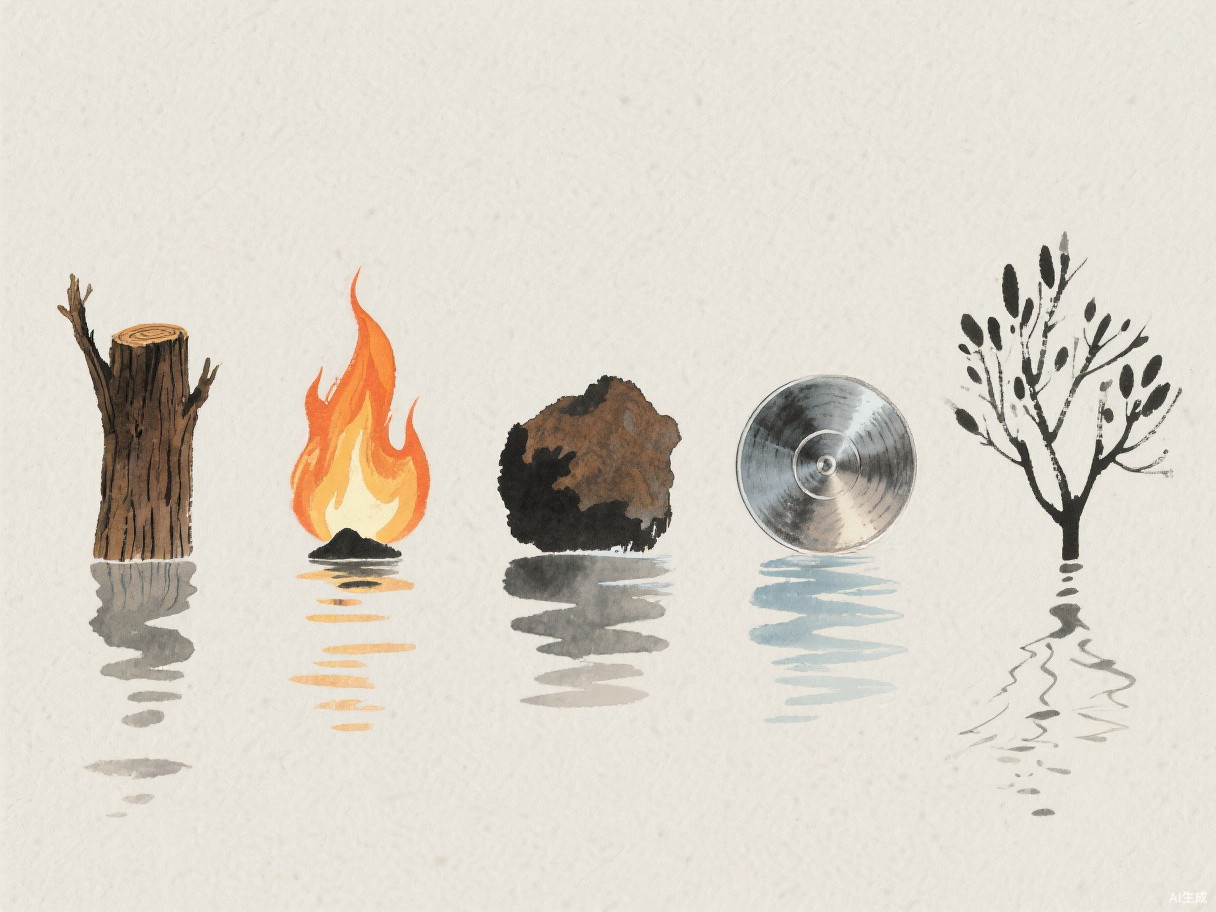
Taoist health practice is layered with the seasons, because qi changes its character through the year. The general pattern from the Nei Jing:
- Spring (Wood) - rise early, move more, eat lighter. The qi is rising; follow it upward.
- Summer (Fire) - rest at midday, hydrate, do not overwork the heart. The qi is at the surface; protect it.
- Late summer (Earth) - the spleen's season. Eat simply, avoid damp-producing foods (excess sweet, dairy, greasy), keep the center clear.
- Autumn (Metal) - earlier nights, earlier mornings, gather the qi inward. The lungs are sensitive; protect them from dry wind.
- Winter (Water) - sleep more, conserve, eat warmer foods. The qi is in storage; do not draw it out unnecessarily.
The seasonal layer is what turns the daily practice from a generic routine into a living relationship with the actual energy of the moment.
The deeper layer: the elemental balance
All of the above is general. The Taoist health tradition does not treat everyone identically, because the elemental balance of your own constitution determines which practices help you and which harm.
A person with a deficient kidney-water constitution should not be told to drink cold water, do hot yoga, and sweat - all three exhaust what they most need to preserve. A person with excess liver-wood should not be pushed toward aggressive gym routines that wind the wood higher. A person with weak spleen-earth should not be given a raw-food cleanse in winter.
This is where a Ba Zi reading earns its place in the health conversation: the elemental balance of your chart tells you which general guidelines apply to you directly, which need to be modified, and which are actively counterproductive for your specific constitution.
Where to begin
If you do not have a chart yet, start with the three pillars - they help almost everyone:
- Eat warm, cooked, regular, with attention.
- Be asleep before midnight, ideally by 10:30 pm.
- Move daily for twenty to thirty minutes, slowly enough to feel your breath.
These three alone, sustained for three months, will shift most people's baseline significantly.
When you are ready for the personalized layer, the Destiny Atlas reads your Ba Zi elemental balance - the same data a longevity practitioner would open with to tell you which of the general guidelines are right for your specific constitution, and which you should modify. The combination of the general pillars and the personal pattern is where the Taoist approach to health becomes precise.
Weekly wisdom, straight to your inbox
Essays, seasonal guidance, and energy insights - one letter a week, no noise.
DaoMind Pro
Read your own chart
Generate your full Ba Zi chart and elemental balance - the same data a practitioner opens with.
Open Destiny Atlas ->