The day master is the anchor of every ba zi reading
A ba zi chart contains eight characters arranged in four pillars - year, month, day, and hour. Seven of those characters describe context: the family you were born into, the season that shaped you, the work you tend toward, the direction your later life travels. The eighth character, the heavenly stem of the day pillar, is different. It is you.
That stem is called the day master (ri zhu, 日主). It is the reference point against which every other character is read. The same element that looks like wealth in one person's chart can look like illness in another's, depending entirely on what their day master is. Without identifying it first, nothing else in the chart means anything.
This is the piece newcomers to ba zi most often skip. They learn the ten heavenly stems and twelve earthly branches, memorize the animals, and start reading predictions - without ever stopping to find the "I" at the center of the chart. This guide fixes that. By the end you will know how to locate your day master, assess whether it is strong or weak, and what that single fact tells you about how to live.
How to locate your day master
The day master is always the top character of the day pillar - the heavenly stem, not the earthly branch. In a standard chart layout:
        Year   Month   Day    Hour
Stem    X      X       ★      X
Branch  X      X       X      X
The starred position is your day master. If your chart is printed on paper or rendered by an app, look for the character directly above the day's animal sign. That is the stem you care about.
To find it without software you need two things: your birth date converted to the Chinese solar calendar (not the Lunar New Year calendar used for festivals), and a wan nian li (万年历, "ten-thousand year calendar") that lists the stem-branch for each day. The day stem resolves at the intersection of the solar month and the day count. Modern ba zi calculators do this in milliseconds - what matters is that you trust a source that uses solar terms, because the month pillar changes at li chun (立春, the start of spring), not on January 1 or Lunar New Year.
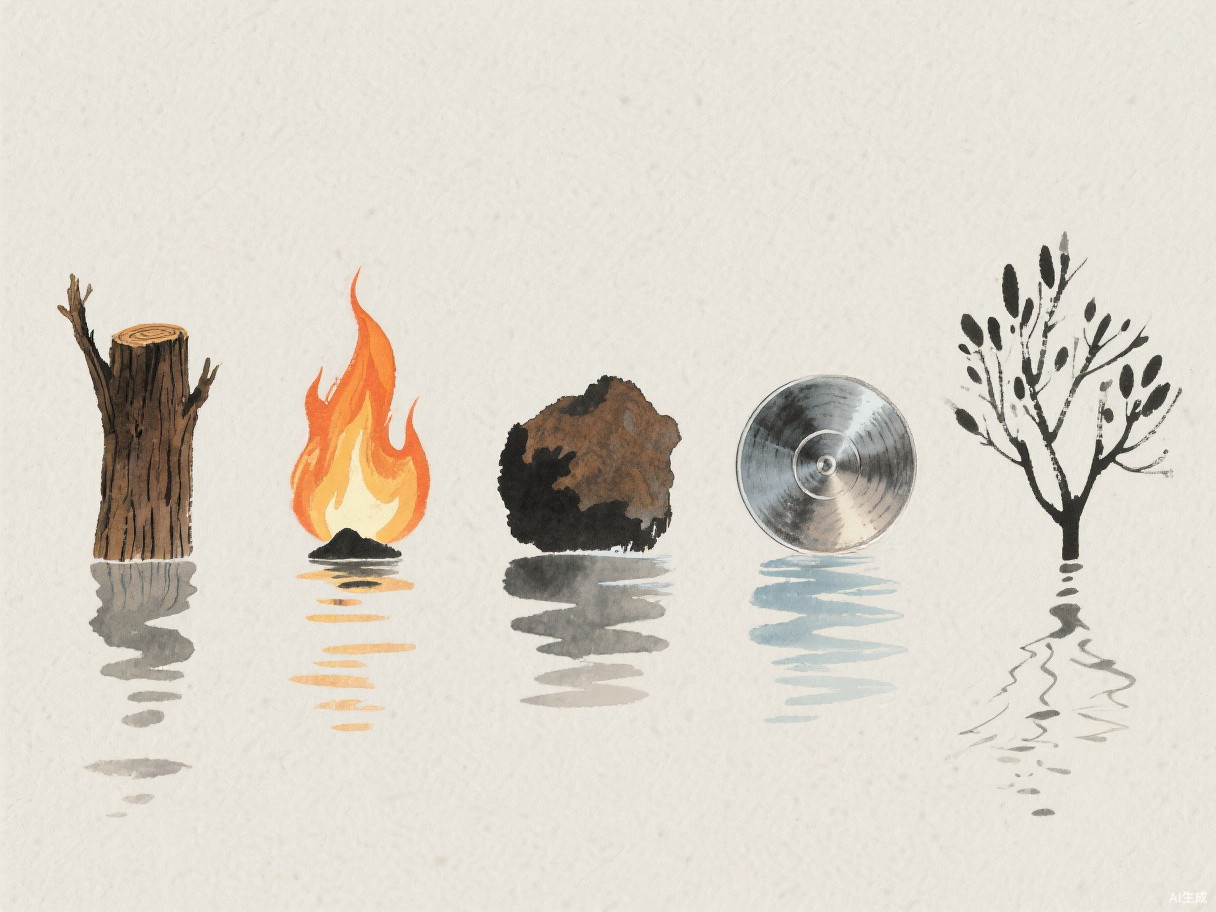
The ten possible day masters are five elements, each in yin and yang form:
- Wood: Jia (甲, yang wood, pine) and Yi (乙, yin wood, flower)
- Fire: Bing (丙, yang fire, sun) and Ding (丁, yin fire, lamp)
- Earth: Wu (戊, yang earth, mountain) and Ji (己, yin earth, garden)
- Metal: Geng (庚, yang metal, sword) and Xin (辛, yin metal, jewelry)
- Water: Ren (壬, yang water, river) and Gui (癸, yin water, rain)
Each carries a temperament. Jia wood grows straight and resists bending; Yi wood winds and adapts. Bing fire illuminates a room; Ding fire warms a corner. The distinction is not decorative - a yang wood day master and a yin wood day master need completely different support.
Strong or weak: the question that decides everything
Once you know your day master's element, the next question is whether it is strong or weak in the chart. This is not a moral judgment and it is not fixed for life - it is a balance reading at the moment of birth, and it determines which elements help you and which elements drain you.
A day master is strong when it receives support from:
- the season (born in wood month for a wood day master, for example)
- other stems and branches of the same element
- the element that generates it (water feeds wood)
A day master is weak when it is surrounded by elements that control or drain it - metal chopping wood, fire burning it, earth consuming its energy. Most people's charts sit somewhere in the middle, and a trained reader scores strength across several weighted factors rather than calling it as a binary. But you can sense the direction quickly by looking at what dominates the chart.
The rule that follows is the one students find most counterintuitive: a strong day master needs to be drained or controlled; a weak day master needs to be supported. A strong Jia wood person drowning in more wood does not need another forest. They need metal to prune, fire to express, earth to root into. A weak Jia wood person needs water and more wood before anything else helps.
This is why generic element advice ("lucky colors for wood people!") is useless. The same color green that rescues a weak wood person traps a strong one.
What the ten day masters actually want
The list below is a starting sketch, not a full reading. Each day master has a characteristic direction of energy, and the useful elements shift depending on strength.
Jia (yang wood) grows upward and resists constraint. At its best it is independent, principled, a natural leader. At worst it is rigid and argumentative. Strong Jia benefits from metal (discipline, cutting) and fire (expression). Weak Jia needs water and wood.
Yi (yin wood) is the vine, the flower, the networker. It survives where Jia breaks by winding around obstacles. Strong Yi can become scattered or manipulative; it needs metal to define a shape. Weak Yi needs water and gentle wood.
Bing (yang fire) is the sun - generous, visible, warm to everyone, sometimes exhausting to be close to. Strong Bing needs water to cool and earth to ground; weak Bing needs more wood to feed it.
Ding (yin fire) is the candle and the altar lamp - focused, intimate, capable of sustained concentration. Strong Ding can burn too hot in a small room; it needs earth to contain it. Weak Ding needs wood.
Wu (yang earth) is the mountain - still, reliable, slow to move. Strong Wu can be stubborn and blocked; it needs wood to loosen and metal to drain. Weak Wu needs fire to generate it.
Ji (yin earth) is the garden soil - fertile, nurturing, absorbent. Strong Ji can become boggy and anxious; it needs wood to aerate. Weak Ji needs fire.
Geng (庚, yang metal) is the forged blade - direct, decisive, capable of cutting through. Strong Geng needs fire to temper and water to sharpen. Weak Geng needs earth and metal.
Xin (辛, yin metal) is refined metal - jewelry, the needle, precise and aesthetic. Strong Xin can be cold or cutting; it needs fire to shape. Weak Xin needs earth.
Ren (壬, yang water) is the river - intelligent, moving, hard to contain. Strong Ren needs earth to bank it and wood to channel it. Weak Ren needs metal and water.
Gui (癸, yin water) is mist and dew - sensitive, intuitive, pervasive. Strong Gui can become foggy and indecisive; it needs earth to coalesce. Weak Gui needs metal.
You can already see the pattern: the element that generates you supports when you are weak; the element you generate, the element that controls you, and the element you control become useful when you are strong. The five elements cycle of sheng (generating) and ke (controlling) is the machinery behind every reading. If this is new, start with the five elements guide before going deeper.
How to use the day master in real decisions
A day master reading is not a prediction. It is a calibration. It tells you what kind of support you are running low on, and where you tend to overproduce. Three places where this becomes concrete:
Work. A strong day master who keeps getting promoted into roles that add more of the same element will eventually feel buried. A weak day master in an environment that constantly controls or drains their element will deplete faster than rest can repair. The day master helps you recognize whether a new job feeds you or prunes you.
Relationships. Two people with day masters in a controlling cycle do not automatically clash - a strong person often needs exactly the element that controls them, and a weak person often needs the element that generates them. The interesting question is not "do our elements match" but "what strength is each of us, and does the other supply what is missing."
Health. In Chinese medicine each element maps to organ systems: wood to liver and gallbladder, fire to heart and small intestine, earth to spleen and stomach, metal to lung and large intestine, water to kidney and bladder. A weak or over-taxed day master points at the system most likely to complain first. A weak water person, for example, tends toward depleted kidney qi and needs rest and warmth more than stimulation - which connects directly to the Taoist approach to health and longevity.
Reading your own chart is the start, not the end
The day master is the easiest piece of a ba zi chart to find and the easiest to misuse. A full reading considers the strength score across all four pillars, the hidden stems inside each branch, the luck pillars that shift every ten years, and the current year's interaction with the natal chart. None of that replaces the simple discipline of asking, every time you look at a character: "relative to my day master, is this helping or draining?"
If you want a chart calculated for you - with the day master identified, strength assessed, and useful elements flagged - the DaoMind Pro ba zi engine computes the four pillars, five-element balance, and ten gods pattern from your birth data in seconds. It does the mechanical part so you can spend your attention on the part that actually matters: deciding what to do with what you find.
A chart is not a verdict. It is a weather report for the life you were born into. The day master tells you whether you are standing in a forest, a desert, or a flood - and what kind of seeds are worth planting.
Weekly wisdom, straight to your inbox
Essays, seasonal guidance, and energy insights - one letter a week, no noise.
DaoMind Pro
Read your own chart
Generate your full Ba Zi chart and elemental balance - the same data a practitioner opens with.
Open Destiny Atlas ->