
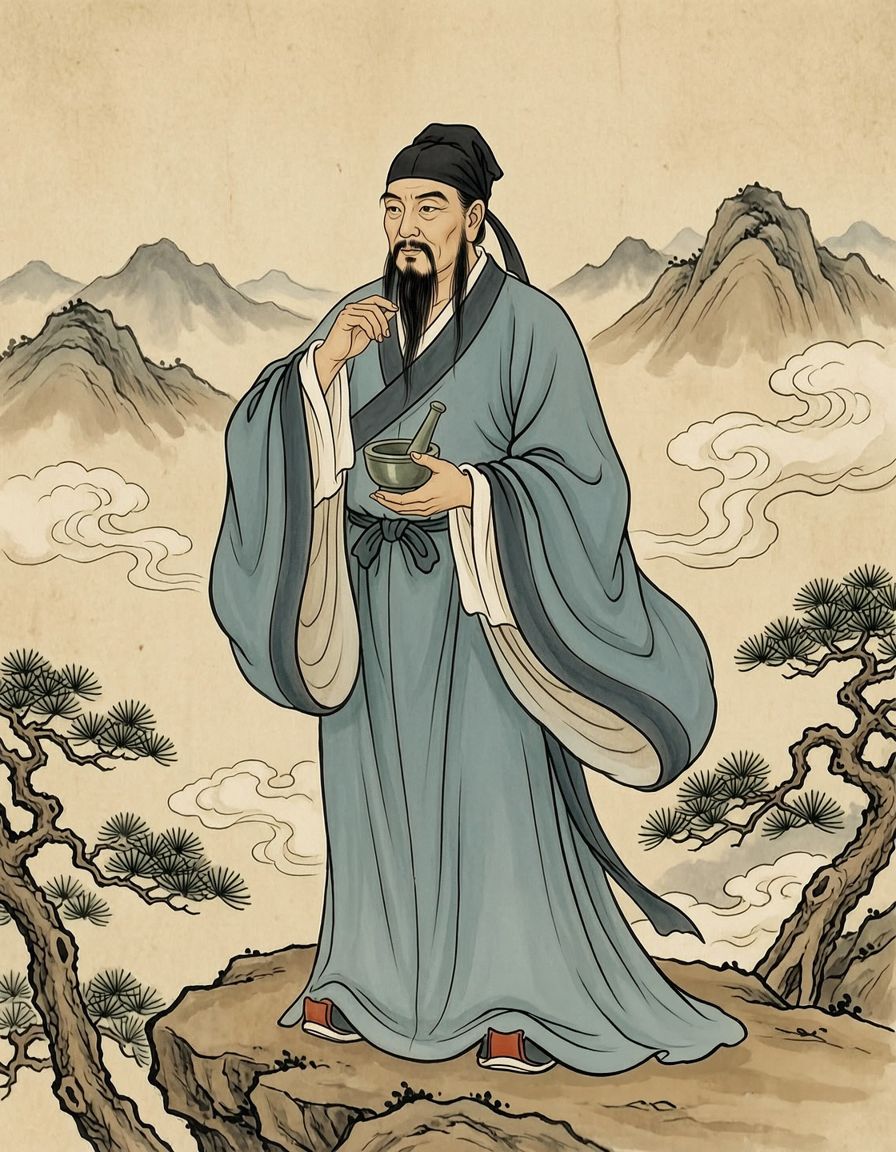
葛洪 抱朴子

Ge Hong, Author of the Baopuzi

The Great Systematizer

Era · 283–343 CE, Jin dynasty

Ge Hong, Author of the Baopuzi (葛洪 抱朴子)

The Great Systematizer

Overview · 概览

The greatest systematizer of early Taoist practice. His Baopuzi defends the quest for transcendence and records the alchemical formulas of his age, while his handbook of emergency medicine saved lives across southern China. He withdrew to Mount Luofu — legend says his body grew light as an empty cicada shell.

Symbols · 象征

  • Baopuzi, the Master Who Embraces Simplicity
  • Zhouhou Fang, handbook of emergency medicine
  • Mount Luofu

Era · 283–343 CE, Jin dynasty

History · 史记

Historical Record

Ge Hong (283–343), courtesy name Zhichuan, styled Master Who Embraces Simplicity, is the great systematizer of early religious Taoism — with an official biography in the Jin Shu. His Baopuzi Inner Chapters codifies the golden-elixir tradition: what immortality is, how it is compounded, which masters transmit it. His Zhouhou Fang, a pocket manual of emergency medicine, contains the world's earliest description of smallpox — and its remedy of qinghao for fevers led, sixteen centuries later, to a Nobel Prize.

He died on Luofu Mountain in Guangdong, where he had retired to compound elixirs. The tradition records his death as a liberation from the corpse: seated, his robe intact, his body light as an empty shell — the immortal had left.

Legends · 典故

Stories of the Divine

羅浮屍解

Liberation from the Corpse at Luofu

A letter from the court arrived summoning him; Ge Hong opened it, laid down his brush, and died in seated posture — or so the Jin Shu tells us. When the coffin was opened the body was light, the robe untouched: liberation from the corpse, the immortal leaving his shell as a calling card.

抱朴之道

The Way of Embracing Simplicity

The Inner Chapters' central argument: immortality is learnable, but only by those who combine golden-elixir work with virtue — to seek long life, first establish merit. The alchemist must also be a good man.

Sources · 典籍来源

Classical Sources

  1. 01

    晉書·葛洪傳

    Jin Shu, Biography of Ge Hong

    The official biography recording his life, works and death on Luofu.

  2. 02

    抱朴子·內篇

    Baopuzi, Inner Chapters

    His own summa of the immortality arts — the foundational encyclopedia of Taoist alchemy.

  3. 03

    肘後方

    Zhouhou Fang

    His emergency medical manual, whose qinghao remedy inspired modern antimalarial discovery.