The Star That Does Not Move
In the Analects Confucius says: he who rules by virtue is like the pole star — it stays in its place while all the other stars pay it homage. Ziwei Dadi is that stillness made divine.

道法自然
中天紫微北極大帝
Master of the Starry Vault
Festival · 18th day of the 4th lunar month
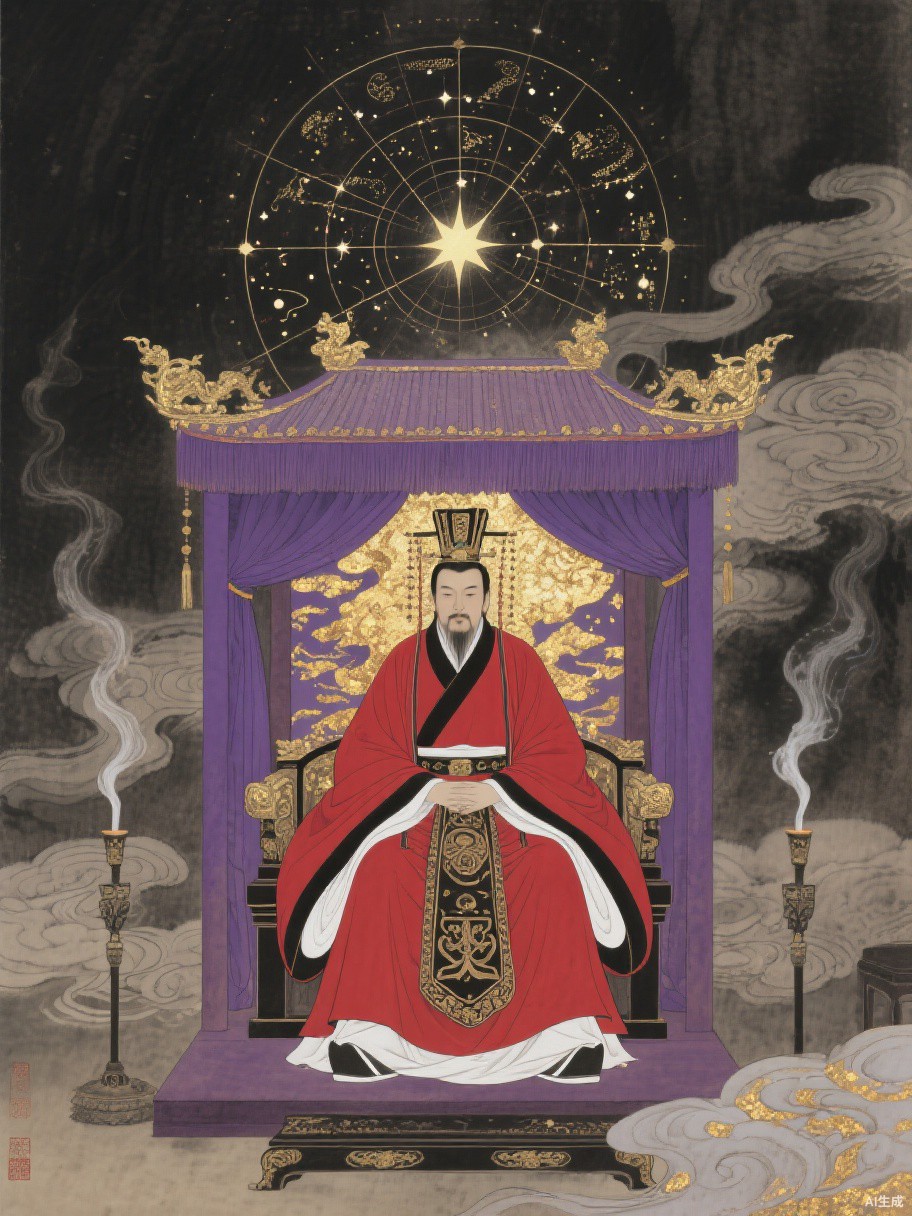
Master of the Starry Vault
Enthroned in the Purple Forbidden enclosure of the pole star, around which all heavens wheel. He governs the celestial calendar, the seasons, and the destinies written in the stars.
Festival · 18th day of the 4th lunar month
History · 史记
Enthroned in the Purple Forbidden enclosure around the pole star, Ziwei Dadi is the still point about which all heavens wheel. His worship reaches back to the earliest Chinese astronomy: Confucius himself compared virtuous rule to the pole star, and Sima Qian's Tianguan Shu mapped the Purple Forbidden enclosure as the palace of heaven's sovereign.
Because the pole never sets, Ziwei Dadi governs what never wavers — the celestial calendar, the turning of the seasons, and the destinies inscribed in the stars. The imperial palace below was laid out as his mirror, which is why the Forbidden City bears his name: Zijincheng, the Purple Forbidden City.
In the Analects Confucius says: he who rules by virtue is like the pole star — it stays in its place while all the other stars pay it homage. Ziwei Dadi is that stillness made divine.
Emperors built their palaces as mirrors of the Purple Forbidden enclosure; to sit on the dragon throne was to sit beneath Ziwei's star. Imperial architecture was applied astronomy.
論語·為政
The Analects passage that first linked the pole star to legitimate sovereignty.
史記·天官書
Sima Qian's treatise on the heavens, mapping the Purple Forbidden enclosure and its stars.
晉書·天文志
The Jin-dynasty star catalogue that fixed the imperial iconography of Ziwei's enclosure.