The Sanctuary at Fenyin
In 113 BCE Emperor Wu of Han crossed the Fen River, established the Houtu sanctuary, and personally offered the first sacrifice — an event he commemorated in his Song of the Autumn Wind.

道法自然
承天效法后土皇地祇
Sovereign of Soil & Harvest
Festival · 18th day of the 3rd lunar month
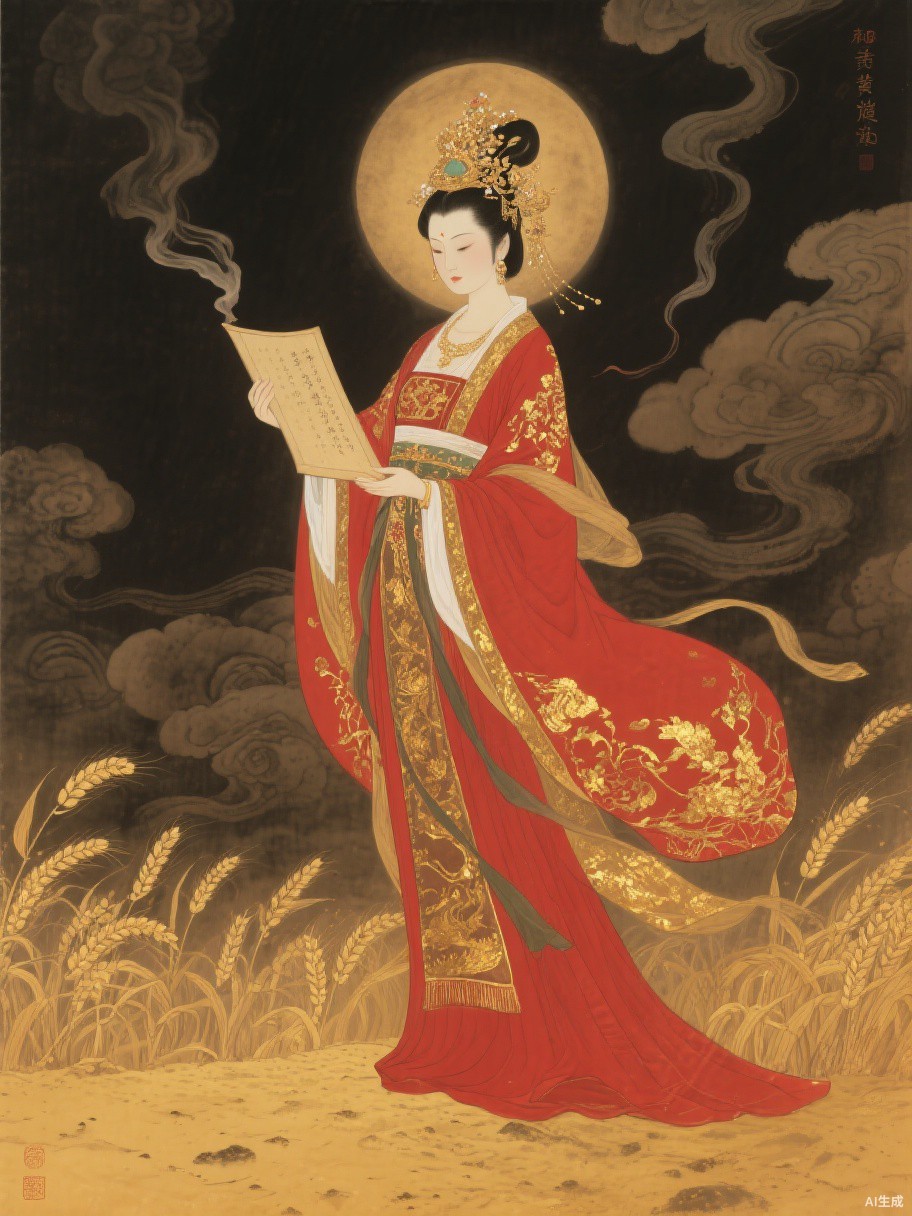
Sovereign of Soil & Harvest
The great goddess who carries the earth itself — counterpart of heaven in the oldest pairing of Chinese worship. She governs soil, harvest, birth and burial, and every altar to the land is hers.
Festival · 18th day of the 3rd lunar month
History · 史记
Houtu — the Sovereign Earth — is among the oldest objects of worship in China, older perhaps than any named god: the earth itself, which bears and nourishes all things. The Zuo Zhuan records earth-altars of the feudal states, and Han emperors established a great state sanctuary of Houtu at Fenyin on the Fen River, where sacrifices were offered alongside those to Heaven.
On every altar she is paired with Heaven — Huangtian Houtu, Imperial Heaven and Sovereign Earth — and in Taoist temples she is honored as mother of mountains, rivers and all that grows. Her square altar reflects the ancient cosmology: heaven is round, earth is square.
In 113 BCE Emperor Wu of Han crossed the Fen River, established the Houtu sanctuary, and personally offered the first sacrifice — an event he commemorated in his Song of the Autumn Wind.
Earth altars were built square to match the earth's form; the round mound of heaven and the square terrace of earth became the twin poles of imperial ritual — surviving today in Beijing's Temple of Heaven and Temple of Earth.
左傳
The Spring-and-Autumn chronicle recording earth-altar worship among the feudal states.
漢書·郊祀志
Records the founding of the Fenyin Houtu sanctuary and its imperial rites.
禮記·郊特牲
The ritual classic explaining the meaning of the earth sacrifice — she who bears all things.